
Low Back Pain: A Core-First Assessment & Treatment Approach
Low Back Pain: A Core-First Assessment & Treatment Approach
This course includes
The instructors
Overview
Your back pain patients aren't getting better. And it's not because you're prescribing the wrong exercises.
It's because they're doing them in a way that reinforces the exact movement patterns that got them hurt in the first place. But these compensations are subtle enough, that they're easy to miss entirely.
This course teaches you how to see them.
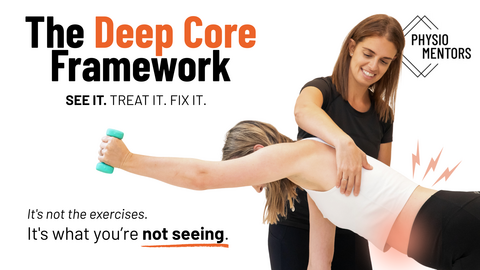
The DEEP CORE FRAMEWORK is your system for assessing and treating low back pain at the source: the core.
Not generic "core strengthening," but a way to actually see how the deep core influences everything: rib cage positioning, pelvic compensation, and the subtle cheats that keep your patients stuck.
And once you understand this framework, you'll start seeing it everywhere: the shoulder that won't stabilize, the hip that keeps flaring up, the post-op patient who can't progress.
Low back pain is the entry point, but the core is the common thread across all of it.
Learning Objectives
Within the DEEP CORE FRAMEWORK, you will learn:
-
How to train your eye to catch what's easily overlooked: the subtle rib cage shifts, pelvic compensations, and movement cheats
-
The difference between the inner and outer core unit, and how they work together in your patients (or fail to)
-
How the diaphragm and pelvic floor influence movement, and why so many "core exercises" fail without this piece
-
How to turn what you're seeing into a clear treatment direction
-
How to prescribe and cue exercises based on what happening in front of you, not just what's "good for the core"
-
How the core influences the entire chain, from shoulder to ankle, and what to do when dysfunction isn't where the pain is
Audience
This course is for physiotherapists and allied healthcare practitioners who treat back pain, post-surgical, postnatal, and orthopedic patients and want a practical framework they can use in everyday clinical practice. It's designed for both new graduates looking to fill the gap between school and clinic, and experienced practitioners who want more clarity and confidence in their core assessment.
The Instructors
Julia Cetnar & Joelle Karam - Physiotherapists, educators, and co-founders of Physio Mentors.
Julia and Joelle each have over 15 years of clinical experience, and they've spent those years doing more than just treating patients. They've pursued extensive continuing education across neurofunctional assessment, contemporary acupuncture, Clinical Pilates, pelvic health, and strength and conditioning — while simultaneously teaching at the McMaster University Contemporary Medical Acupuncture Program, the University of Toronto, and Global Health Works in the US.
That combination matters. They've learned from the best, tested it in their own practices, and then turned around and taught it to others. Over and over, for 15 years. It's made them exceptionally good at taking complex clinical concepts and making them practical, clear, and easy to apply.
They founded Physio Mentors in 2017 to bridge the gap between what's taught in school and what's actually needed in practice. This course is the product of everything they've learned, applied, and refined along the way.
Material Included In This Course
-
Anatomy & Neuroanatomy of the Core
-
Inner vs. Outer Core Unit
-
Diaphragm & Pelvic Floor Function
-
Identifying Compensation Patterns
-
Assessment Walkthrough
-
Exercise Selection & Cueing
-
Practical Movement Demonstrations
Course Access & Completion Policy
Upon purchase of this course, you will have 1 year (365 days) from your date of purchase to complete all course materials and meet the completion requirements.
If you successfully complete the course within the 1-year timeframe, you will be granted lifetime access to the course content at no additional cost.
This means you can revisit the lessons, resources, and materials whenever you need them—long after your initial completion date.
The instructors

BA Kin, MScPT, Neurofunctional Sports Performance Practitioner
Julia's academic journey began at the University of Western Ontario, where she graduated with an Honours Specialization in Kinesiology and a minor in Rehabilitation Science. Her lifelong involvement in athletics and interest in healthcare then led her to study physiotherapy at McMaster University. Julia is currently an instructor with the McMaster Contemporary Medical Acupuncture Program, Dr Mike Prebeg's Foundations in Functional Assessment course, and Dr Dan Wunderlich's Neurofunctional Acupuncture course. She is also an Adjunct Lecturer with the University of Toronto Physical Therapy Program, Vice President of the Canadian Contemporary Acupuncture Association, and editor of the Canadian Contemporary Medical Acupuncture Association's newsletter. She co-founded Physio Mentors with Joelle Karam and has enjoyed working closely with dozens of mentees over the past decade.

BHSc(H), MScPT, Neurofunctional Sports Performance Practitioner
Joelle graduated with a Masters of Science in Physical Therapy from the University of Toronto. Prior to her Masters she received an Honours Degree in the Bachelor of Health Sciences Program from McMaster University. Further, she is a Neurofunctional Contemporary Acupuncture Provider and Certified Strength and Conditioning Specialist. For many years, she held an executive position at the Canadian Contemporary Acupuncture Association, instructed at the McMaster Contemporary Acupuncture Program, and with Dr Mike Prebeg’s Foundations in Neuro-Functional Assessment course. She moved to Australia 5 years ago where she became trained in Clinical Pilates and has opened a multidisciplinary clinic in the South Coast of New South Wales. She maintains her connection to her profession in Canada through ongoing clinical educator roles with the University of Toronto Physical Therapy Program, and through Physio Mentors Inc, which she co-founded with Julia Cetnar.
Material included in this course
-
Introduction & Resources
-
Introduction
-
Course Slides
-
Anatomy
-
Inner Core - Diaphragm Anatomy
-
Video - Diaphragm
-
Inner Core - Transverse Abdominis
-
Video - Transverse Abdominis
-
Inner Core - Pelvic Floor Muscles
-
Inner Core - Multifidus
-
Inner Core - Neuroanatomy
-
What Happens During the Breath Cycle
-
Outer Core - Rectus Abdominis
-
Outer Core - External Oblique
-
Outer Core - Internal Oblique
-
Core Contraction Under Ultrasound
-
Fascial Slings
-
Anatomy Key Points
-
Feedback
-
Theoretical Concepts and Practical Application
-
Theoretical Concepts and Practical Application
-
Feedback
-
Putting it into Practice
-
Assessment - Sagittal Plane Pelvic Positioning
-
Video: How to Evaluate Sagittal Plane Pelvic Positioning
-
Cuing - Sagittal Plane Pelvic Positioning
-
Video: How To Find a Neutral Sagittal Plane Pelvis Position
-
Assessment and Cuing - Sagittal Plane Ribcage Positioning
-
Video: How to find Neutral Ribcage Positioning
-
Assessment - Transverse Plane: Relationship Between Pelvis and Ribcage
-
Video: How to Evaluate the Relationship Between Pelvis and Ribcage Position
-
Cuing - Transverse Plane Ribcage Positioning
-
Assessment and Cuing - Where is the Weight in the Feet?
-
Video: How to Stack the Ribs Over the Pelvis
-
Assessment: Breathing
-
Video: How to Assess and Cue Breathing
-
What Happens During the Breath Cycle
-
Video: How to Activate the Inner Core
-
Cuing - Coordinating Breathing and Pelvic Floor Function
-
Assessment: Supine
-
Video: What to Observe in Your Patient While They Are in a Supine Position.mov
-
Assessment and Exercise Prescription - Supine Movements
-
Video: How to Evaluate Core Stability in a Supine Position
-
Supine Movements - Bridging
-
Assessment and Cuing - Standing Functional Movements
-
Video: How to Assess and Cue Squats.mov
-
Video: How to Assess and Cue Single Leg Stance and Single Leg Squats.mov
-
Video: Using a Split Squat Position to Integrate Core Stability Skills.mov
-
Common Compensatory Standing Movement Patterns and What They Mean
-
Assessment & Treatment: Four Point Position
-
Video: How to Train Anti-Rotation Core Stability in a Quadruped Position.mov
-
Video: How to Cue Breathing in a Quadruped Position.mov
-
Common Compensatory Movements - 4 Point Position
-
Assessment and Treatment: Side Lying
-
Video: How to Train Coronal Plane Stability in a Side Lying Position.mov
-
Common Compensatory Movements - Side Lying Position
-
Feedback
-
Summary
-
Summary
-
Thank You!
-
How to get lifetime access to this course
What will I learn in this course?
You will gain a comprehensive understanding of how the inner and outer core units function and interact, the role of the diaphragm and pelvic floor in core stability, and how to assess and address dysfunctional movement patterns. The course emphasizes practical application—teaching you how to guide patients in reconnecting with their bodies, improving motor control, and selecting exercises that restore efficient movement and core function.
How is the course structured?
The course is delivered through a combination of short lectures and video demonstrations. It begins with a review of relevant anatomy and neuroanatomy, followed by practical modules that translate theory into clinically applicable movement strategies.
Is this course hands-on or theory-focused?
The course integrates both theory and practice. While the early modules establish a strong theoretical foundation, the latter sections focus on practical application through demonstrations, movement assessments, and exercise progressions that can be immediately implemented with clients or patients.
Do I need any prerequisites to enroll?
A background in anatomy, movement, or rehabilitation is recommended but not mandatory. The course is designed to be accessible to professionals across various disciplines who wish to deepen their understanding of core function and retraining.
How can I apply what I learn in my practice?
You will leave the course with a structured framework to assess, cue, and progress core retraining strategies in your patients or clients. The material is directly applicable to clinical rehabilitation, performance training, and general movement coaching.
How does this course differ from other core training programs?
This course moves beyond traditional strength- or stability-based approaches to core training. It emphasizes the integration of anatomical, neurological, and functional principles to develop a comprehensive understanding of how the core truly operates. The focus is on restoring coordinated movement and neuromuscular control rather than isolated muscle activation or generic strengthening.